
Even when grasping for the biggest historical analogies, the numbers are hard to wrap your head around.
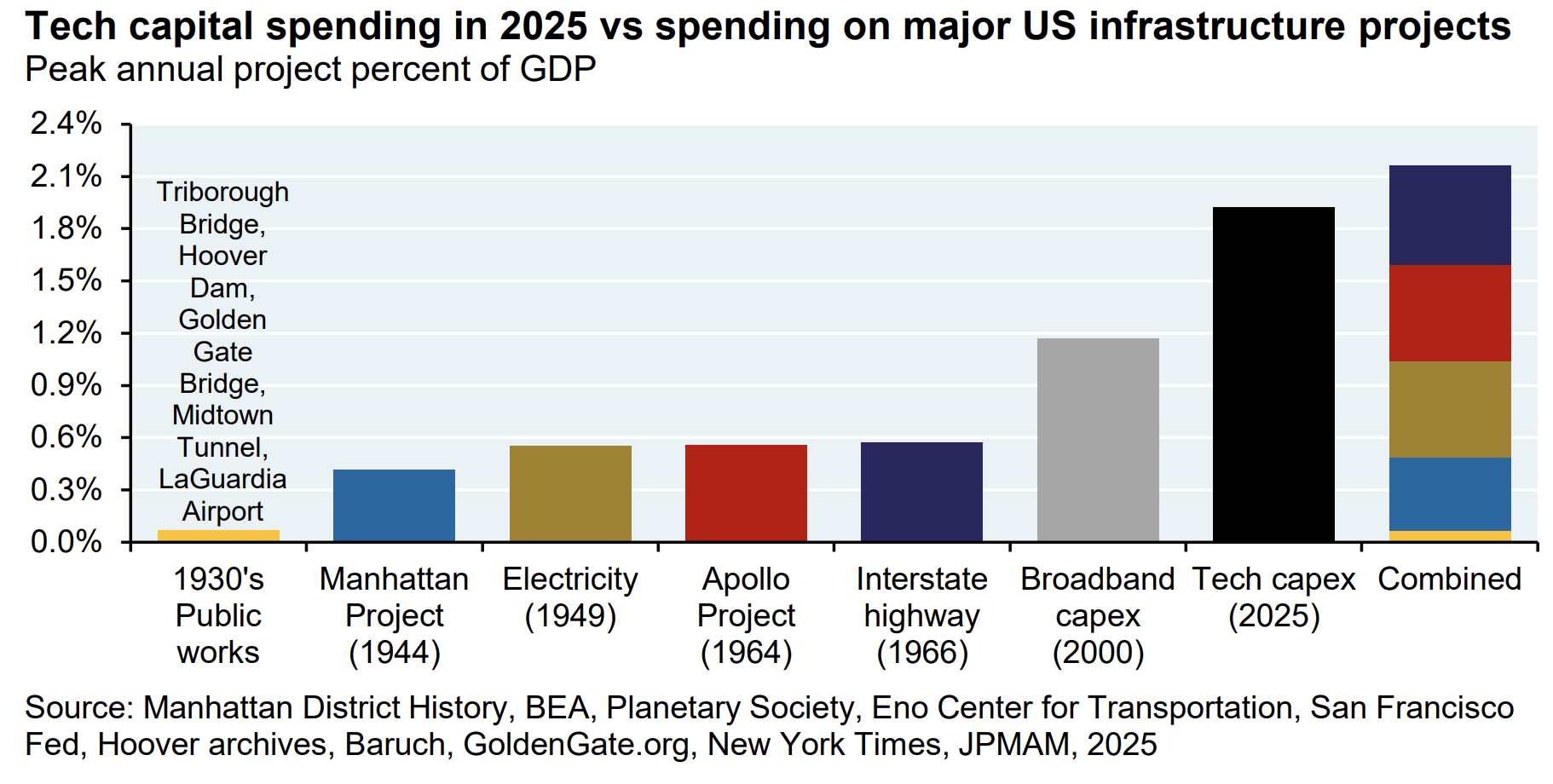
Current AI capital spending, as a share of GDP, now exceeds the combined peak annual investment in the Manhattan Project, the interstate highway system, the Apollo program, and the 1940s electricity build-out simultaneously. And unlike those prior eras, this is a story of private capital, not government intervention.
Is this a bubble? As Derek Thompson recently wrote, “Nothing like this has ever happened before, and if you feel extremely confident about how this is going to turn out, I think you might be crazy.”
A more useful question: are the systems receiving this unprecedented investment able to handle the load?
Not technically, but institutionally.
The early evidence suggests the answer is: not yet. Consider what’s happening in state legislatures. Since 2021, 533 data center bills have been introduced across all 50 states, a figure that has grown more than eightfold. We’re not even halfway through 2026, and 262 bills are under consideration.
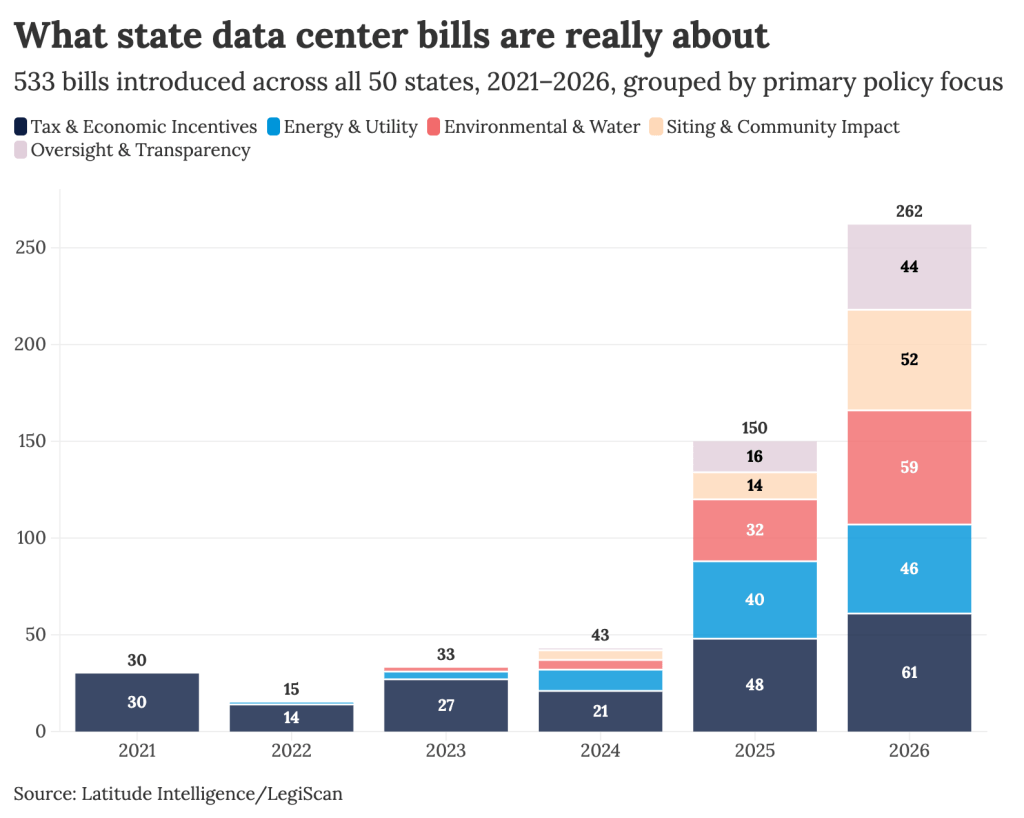
The volume alone is striking, but the more telling shift is in the mix.
Five years ago, data center legislation essentially meant tax incentives and economic development bills. Today, energy regulation, environmental requirements, siting restrictions, and oversight mandates make up more than three-quarters of the total. Twelve states are now considering legislative moratoriums on new construction entirely.
This is the institutional response to the capital surge, not a top-down national strategy but a decentralized experiment in real-time. The unprecedented physical infrastructure buildout is playing out across state houses, utility commission dockets, and zoning boards, one bill or one project at a time.
As AI deployment accelerates, institutional barriers may become the governing limit to progress. As Azeem Azhar argues, “frontier training now looks less like a pure research challenge and more like an industrial scaling problem.”
The institutions facing the business end of this growth were built long before the Scaling Era. How fast they adapt to an accelerating world is this year’s $700 billion question.